
Directed by Edward Berger
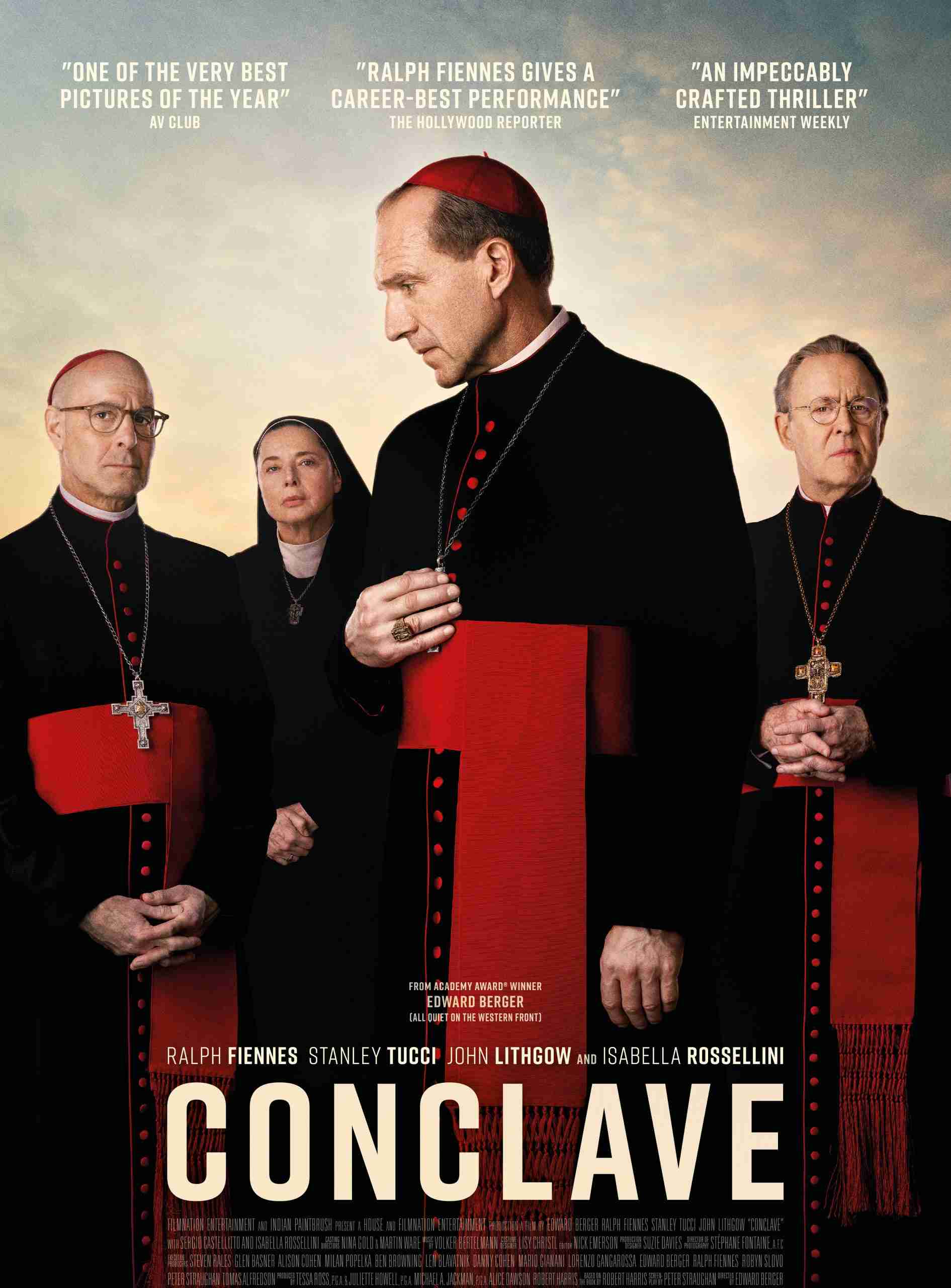
In Conclave, the incomparable Ralph Fiennes guides us through the story of human ego, the papal election process, and the consequences of these two forces converging. As Dean of the College of Cardinals, the necessary conclave becomes his responsibility when the current pope passes away. Throughout the process, the sequestered Cardinals expose secret desires, exact ploys for power, succumb to revengeful tactics, and ultimately determine a new way forward for the Catholic Church.
In a similar vein to many other films and novels about the politics of the papacy, Conclave adheres to the methods of traditional political dramas — it’s very West Wing, very The Crown — while injecting some Sopranos-esque crime family tensions topped off with in-depth depictions of a conclave’s ritual machinations.
On this note, Conclave could have been too slow-moving were it not for the cinematic interest. This content, these colors — Cardinal red, Roman gold, the dim yellow lighting of the Vatican — were designed for visual significance, and they are portrayed beautifully.


The plot & characters
As Dean Lawrence (Fiennes) works to uncover truths about his Brother Cardinals in an effort to maintain the moral direction of the last pope, he is aided by supporters, attacked by opponents, and shocked by allies-turned-enemies. Unfortunately, none of the twists are particularly surprising for us viewers.
We’re introduced to conflict almost immediately when Cardinal Tremblay (John Lithgow) suspiciously announces he chose to “wait and create a timeline” of the pope’s last day before calling in the other Cardinals. Again when the unknown Archbishop Benitez (Carlos Diehz) arrives from Kabul and shares he was named in pectore. And again when Cardinal Adeyemi (Lucian Msamati) has a public confrontation with a nun recently transferred from Nigeria.
As we meander through the voting process, disrupted every once in a while by arguments or car bombs, we stayed locked primarily on Lawrence. His right hand, Monsignor O’Malley (Brian F. O’Byrne), fetches information for him as needed. His frenemy, Cardinal Aldo Bellini (Stanley Tucci), tries tirelessly to manage his own ambitions against his perception of Lawrence’s desires and his anger at their shared rival, Cardinal Tedesco (Sergio Castellitto), a traditionalist bent on reimposing Roman conservatism.
Lawrence is somewhat unwillingly trapped in the middle of it all — in fact, he reveals he requested and was denied his own resignation months earlier. But of course, as Bellini states, “every cardinal harbors a secret desire to be pope,” which Lawrence himself may share.
Whenever the Cardinals are not in session, they are looked after by a team of nuns led by Sister Agnes (the incredible Isabella Rossellini). She moves the story along in her quietly intense way, shaking the room with a revelation launched by one of the best quotes of the film: “Although we sisters are meant to be invisible and silent, God has nevertheless given us eyes and ears.” As the stakes grow higher — a mixture of personal scandals, theological convictions, and, at times, doubts of faith — the atmosphere is charged until a new pope is finally chosen.
But the last ten minutes of this film hold their own secret, one that has stirred controversy and garnered discussion since its release (despite the fact that it closely follows the source material, Robert Harris’s 2016 novel by the same name).
The ending (major spoiler)
Yes, Mexican Cardinal Benitez is elected pope following his speech to the college pleading for peace: “We cannot think of ideals before with think of each and every man and woman. The church is not tradition. The church is not the past. The church is what we do next.”
After his acceptance, when speaking privately with Lawrence, he shares that, during an appendectomy in his late 30s, doctors discovered ovaries and a uterus about which he was previously unaware. Although he once made an appointment at a gender reassignment clinic to remove them, he ultimately decided it would be “more of a sin to alter His handiwork than to keep my body the way it is.”
The themes
Cardinal Benitez is representative of every major theme, perhaps the most prominent of which interestingly is not revealed until the final minutes and not at all explored by the plot — the meaning of gender. Benitez was raised as a boy, outwardly presents as male, considers himself a man, and had no knowledge of his internal organs until accidentally discovering them when he was nearly forty years old. The existence of this uterus was not something he “chose” for himself. Despite this, many would consider him a biological woman.
A lack of faith in the Catholic Church plagues Lawrence throughout the story. Ultimately, this is the story of a man who is experiencing doubt about where (and in whom) to place his faith for the future of his beloved Church. As it turns out, that future will likely push the Church to become more accepting, inclusive, and open to something wider than Roman traditionalism. Not only is Benitez not Italian, not even European, not even white — he is intersex. He’ll make decisions differently than any pope who has come before.
Many Catholics are, unsurprisingly, quite angry over this film.
It’s critical to understand that the novel was released in 2016, a few years after the resignation of Pope Benedict XVI and subsequent election of Pope Francis. Anti-Muslim sentiment was high amid the rise of ISIS (note: Benitez’s character was from Baghdad in the original story).
Final thoughts
Even if you hate the plot, it’s worth watching for the beauty of the camerawork. Watch it on mute if you need to. I’d frame nearly any still from this film.
Conclave is a quiet thriller with subtle but thematically rich exploration of faith and ego. Material from some of the most heated debates of the past decade (past century? all of civilization?) — race, gender, faith, the Catholic Church, power, sabotage — collide here, marrying political intrigue with personal struggle.
As viewers, we’re asked to reconsider the boundaries between tradition and transformation. People will leave this movie “on a side” — it’s a conversation for the Thanksgiving table (🤮), and (although we want more Isabella Rossellini than we ultimately get) it tells its story well enough.
This movie is good.
My rating: 3.5/5
Leave a Reply